
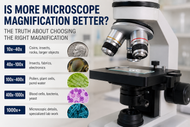
Is More Microscope Magnification Better? The Truth About Choosing the Right Magnification
Aug 1st 2026
When shopping for a microscope, it's easy to assume that bigger numbers mean better performance. You'll often see microscopes advertised with magnifications of 2000x or even 2500x, making it sound like more magnification automatically lets you see more.
The reality is different.
The best microscope isn't the one with the highest magnification. It's the one that provides the right combination of magnification, resolution, image quality, and optics for the specimen you're examining. In many cases, increasing magnification beyond what's needed simply produces a larger blurry image instead of revealing additional detail.
Whether you're buying a microscope for education, research, industrial inspection, or personal use, understanding how magnification really works will help you choose the right instrument and avoid one of the most common buying mistakes.
Why More Magnification Isn't Always Better
Magnification and image quality are not the same thing.
Magnification simply makes an object appear larger. Resolution is what determines how much detail you can actually see.
Imagine taking a low-resolution photograph and zooming in on your computer. The image becomes larger, but it doesn't become sharper. Eventually, everything just looks blurry and pixelated.
Microscopes work the same way.
Once you've reached the useful optical limit of the microscope, increasing magnification doesn't reveal new details. It simply enlarges what is already visible.
The best microscope provides the highest image quality at the magnification appropriate for your application, not necessarily the highest magnification available.
Magnification vs. Resolution: What's the Difference?
These two terms are often confused, but they play very different roles.
|
Magnification |
Resolution |
|
Makes an object appear larger |
Determines how much detail you can distinguish |
|
Controlled by the objective and eyepiece lenses |
Determined by the quality of the optics and the wavelength of light |
|
Can easily be increased |
Has physical limits in light microscopy |
|
Does not automatically improve image quality |
Produces sharper, clearer images |
Think of magnification as making a picture bigger and resolution as making it clearer.
If the microscope doesn't have enough resolving power, increasing magnification won't reveal any additional information.
What Is "Empty Magnification"?
One of the most important concepts in microscopy is empty magnification .
Empty magnification occurs when a microscope enlarges an image beyond the point where any additional detail can be resolved.
Instead of seeing more, you simply see a larger version of the same image.
For example, if two bacteria cannot be distinguished at 1000x because of the optical limits of the microscope, viewing them at 2000x won't suddenly separate them. The image becomes larger, but no new information appears.
Professional microscopists try to avoid empty magnification because it reduces image quality without providing any benefit.
What Can You Actually See at Different Magnifications?
Different specimens require different levels of magnification. Higher isn't automatically better. The right magnification depends entirely on what you're trying to observe.
|
Magnification |
Typical Uses |
|
10x to 40x |
Coins, rocks, insects, plants, circuit boards, gemstones |
|
40x to 100x |
Small insects, fabrics, electronic components, larger biological specimens |
|
100x to 400x |
Plant cells, pond water, algae, protozoa, pollen |
|
400x to 1000x |
Blood cells, bacteria, yeast, tissue samples |
|
Above 1000x |
Specialized laboratory applications using oil immersion objectives |
Notice that many common applications never require extremely high magnification.
A geologist examining minerals, an electronics technician inspecting circuit boards, or a jeweler evaluating gemstones often achieves better results with a stereo microscope operating below 50x than with a compound microscope at several hundred times magnification.
Is a 2500x Microscope Better Than a 1000x Microscope?
Not necessarily.
Most professional biological light microscopes are designed to deliver their maximum useful optical performance at approximately 1000x magnification , typically using a 100x oil immersion objective and a 10x eyepiece.
Some microscopes advertise much higher magnifications by pairing stronger eyepieces with the same objective lenses. While this increases the size of the image, it doesn't necessarily increase the amount of detail you can see.
That's because the optical resolution of the microscope remains unchanged.
A well-built microscope with excellent optics at 1000x will often produce a clearer, more useful image than a lower-quality microscope advertising much higher magnification.
When comparing microscopes, pay close attention to the quality of the optics, numerical aperture, illumination system, and objective lenses rather than focusing solely on the magnification printed on the box.
Why Scientists Don't Always Use the Highest Magnification
One surprise for many first-time microscope buyers is that professional scientists rarely use the highest magnification available.
Instead, they choose the lowest magnification that clearly shows the structures they need to observe.
Lower magnifications offer several important advantages:
- Larger field of view
- Brighter images
- Better depth of field
- Easier focusing
- Faster specimen scanning
For example:
Blood Cell Analysis
Most blood smears are routinely examined around 400x for scanning and 1000x with oil immersion when evaluating individual blood cells.
Plant Biology
Many plant tissues, leaves, and stems can be studied effectively between 100x and 400x.
Electronics Inspection
Circuit boards, solder joints, connectors, and components are commonly inspected using stereo microscopes between 10x and 40x.
Gemology
Gemologists typically examine diamonds and colored gemstones around 10x to 40x because this provides the ideal balance between detail and working distance.
Manufacturing and Quality Control
Inspectors often work between 20x and 200x depending on the size of the parts and the level of detail required.
Each application has an optimal magnification range. Going beyond that range often makes the work more difficult rather than easier.
Choosing the Right Magnification for Your Needs
Instead of asking, "What's the highest magnification available?" ask, "What am I trying to see?"
Students
Students learning biology generally achieve excellent results using microscopes capable of 40x to 400x, while more advanced coursework may require up to 1000x for viewing bacteria and blood cells.
Explore our Student Microscopes to find models designed for classrooms, homeschool environments, and college courses.
Hobbyists
Collectors, hobbyists, and nature enthusiasts often need multiple magnification ranges depending on the specimens they enjoy observing.
Coins, insects, rocks, plants, and other larger objects are frequently best viewed with stereo microscopes under 50x.
Biological Research
Researchers studying cells, tissues, microorganisms, and biological specimens typically work between 100x and 1000x using high-quality compound microscopes with professional-grade objectives.
Clinical Laboratories
Medical laboratories commonly rely on 400x and 1000x magnification for blood analysis, microbiology, pathology, and diagnostic procedures.
Industrial Inspection
Industrial applications vary widely depending on the product being inspected.
Semiconductors, machined components, electronics, welds, and manufactured parts often require specialized microscopes designed around the proper working distance and optical performance rather than maximum magnification alone.
Other Features That Matter More Than Magnification
When choosing a microscope, consider the complete optical system.
Important features include:
Optical Quality
Higher-quality objective lenses produce sharper images with greater contrast and improved color accuracy.
Numerical Aperture
Objectives with higher numerical apertures gather more light and resolve finer detail.
Illumination
LED, halogen, brightfield, darkfield, phase contrast, fluorescence, and polarized illumination all affect image quality depending on your application.
Mechanical Stability
A sturdy frame, precise focus controls, and smooth stage movement make microscopy much easier and more enjoyable.
Camera Compatibility
If you plan to capture images or perform measurements, digital imaging capabilities may be more valuable than additional magnification.
Making a Smarter Microscope Purchase
Choosing a microscope based solely on magnification is like choosing a camera based only on digital zoom.
Higher numbers may look impressive, but they don't automatically produce better images.
For most applications, selecting the appropriate magnification range, combined with high-quality optics and proper illumination, will provide far better results than simply buying the microscope with the biggest number advertised.
Whether you're examining insects, plant cells, bacteria, circuit boards, gemstones, or industrial components, the best microscope is the one designed for your specific application.
Understanding how magnification, resolution, and optics work together will help you make a more informed decision and enjoy clearer, sharper, and more meaningful observations.
Frequently Asked Questions About Microscope Magnification
Is a higher magnification microscope always better?
No. Higher magnification only enlarges the image. Without sufficient optical resolution, increasing magnification won't reveal additional detail and may actually reduce image quality.
What is the maximum useful magnification for a light microscope?
For most standard optical light microscopes, approximately 1000x is considered the practical upper limit for useful optical magnification. Beyond that point, additional magnification often results in empty magnification rather than increased detail.
What is empty magnification?
Empty magnification occurs when a microscope enlarges an image without revealing any additional detail because the optical resolution has already reached its limit.
Can you see bacteria with a microscope?
Yes. Many bacteria can be observed using a compound microscope with a 100x oil immersion objective, providing a total magnification of around 1000x.
Can you see viruses with a light microscope?
Most viruses are too small to be resolved with a traditional light microscope and require electron microscopy for detailed imaging.
How do I know what magnification I need?
The correct magnification depends on what you're examining. Larger objects like insects, rocks, and electronic components often require less than 50x, while cells and microorganisms typically require between 400x and 1000x.


