
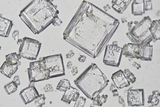
Salt Under a Microscope: What Salt Crystals Really Look Like
Sep 21st 2026
Salt may look like nothing more than tiny white grains when sprinkled onto food, but put those same grains under a microscope and they become surprisingly geometric.
Under a microscope, table salt appears as transparent or translucent cube-shaped crystals with flat faces, straight edges and right-angle corners. Some grains form nearly perfect cubes, while others appear broken, stacked or irregul
…

Parts of a Compound Microscope: Labeled Diagram, Functions & Guide
Sep 16th 2026
A compound microscope uses a combination of lenses, illumination components and mechanical controls to produce a magnified view of specimens that are too small to see clearly with the naked eye. While designs vary between models, most compound microscopes share the same essential parts.
The main parts of a compound microscope include the eyepiece, objective lenses, revolving nosepiece, stage, cond
…

Cheek Cells Under a Microscope: What They Look Like and How to View Them
Sep 8th 2026
Cheek cells are one of the easiest types of human cells to observe under a microscope. A simple sample collected from the inside of the cheek can reveal individual cells, their boundaries, cytoplasm and nuclei, providing a close-up look at the basic structures that make up the human body.
Under a microscope, human cheek cells typically appear as thin, flat, irregularly shaped cells with a clearly
…
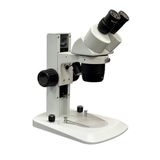
Dissecting Microscope Guide: Uses, Magnification, Parts & How to Choose One
Aug 27th 2026
A dissecting microscope, also called a stereo microscope, is designed for viewing larger, three-dimensional objects at relatively low magnification. Instead of examining thin specimens mounted on microscope slides, a dissecting microscope allows you to look at the surface of objects such as insects, plants, rocks, circuit boards, manufactured components and other solid specimens.
The combination o
…


